
Ilan Stavans is the Lewis-Sebring Professor of Humanities and Latin American and Latino Culture at Amherst College, the publisher of Restless Books, and a consultant to the Oxford English Dictionary. He is a New York Times bestselling author and the recipient of numerous international awards. His work, translated into twenty languages, has been adapted into film, TV, radio, and theater.

Request Academic Copy
Please copy the ISBN for submitting review copy form
Description
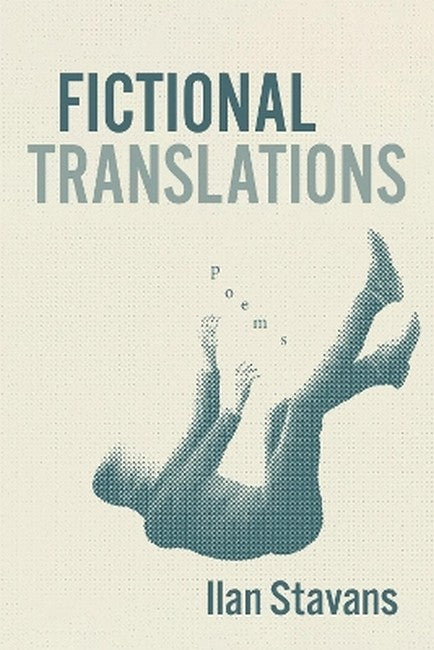
"Like two of his greatest models, Fernando Pessoa and Jorge Luis Borges, Ilan Stavans contains multitudes, and in this madcap literary adventure, he hosts, translates, channels, and reinvents a chorus of great poets who have made their mark in many different languages over the centuries. These imitations and inventions question originality, blur the lines between poetry and translation, and enlarge literature. The result is an anthology unlike anything else I've ever read."--Edward Hirsch "One of the truly exemplary writers, thinkers, persons of letters, sustainers of what most matters."--Jane Hirshfield "Stavans gives us not a book but a library, not an event but a festival of events, all in one volume, many traditions in the mirror of one man's eyes. It is refreshing, in this age of factual horrors and fake truths, to find a poetic voice that takes on the bewilderment of our moment and points to how it, too, can become an originator for creation, invention, and celebration of imaginative capacities of a human voice. . . . Translation is an art, and art transforms close attentiveness into something larger, something that can cross borders, survive the test of time. When we translate words in a quiet room, we enter a communion with a company much larger than ourselves. Multiple voices that once lived in and with that language sit near us, in that quiet room, and read that text with us. 'Translation is the slowest way to read a poem, ' one of Stavans's invented commentators asserts. Indeed. And this book, with its bold claim of translator as heteronym, offers us many possible ways of reading, of seeing."--Katie Farris and Ilya Kaminsky "Stavans has not only invented excellent plausible counterfeit poems by eminent authors of past and present, but has gone on to admirably fake the translations of those very forged verses into English and, also, as if this were not enough, concocted, to accompany him in this delirious enterprise, a multitude of make-believe translators from different countries and languages, ultimately weaving a Borgean tapestry of beauty and illusions that leave me breathless with joy at such audacity and beauty."--Ariel Dorfman "With all the debates about translation, one question has gone missing: Can it be fun? In this witty book, Ilan Stavans, one of our most cherished denizens of the lands between languages, invents a territory inhabited not by literal words but by the spirits--clashing, absurd, poetic--of different literatures."--Benjamin Moser "Ilan Stavans exudes a joie de vivre and a voracious appetite for linguistic play. In Fictional Translations, he summons a dozen heteronyms to translate a canon of imaginary poems and essays. By pairing fictitious translators with invented texts allegedly written by a who's who of literary history, Stavans poeticizes with a tender but irreverent sense of humor what Hannah Arendt famously defined as taste: 'a principle of organization of who in the world belongs together and how we recognize each other.' But there is a reverence inside the irreverence. In an era of fake news and fragmented realities, this is a timely experiment that creates a literary deepfake to recapture truth and beauty."--Giannina Braschi, author of Yo-Yo Boing! and Putinoika "Magnificent, audacious, cosmological--Fictional Translations unleashes signature Stavans. Translators real and invented conjure poems that never were, transforming the productive blunder into pure eros. Stavans shatters the tyranny of the original, channels Petrarch through Middle English, decolonizes Neruda, and crowns translation the supreme act of literary love. Nobody thinks and plays language with such depth, verve, and liberatory daring. A polyphonic tour de force that forever unseats the myth of translation as spectral servitude!"--Frederick Luis Aldama, author of Formal Matters in Contemporary Latino Poetry