
Richard Chasin, MD, Family Institute of Cambridge, Watertown, MA; Harvard Medical School at Cambridge Hospital, Cambridge, MA. Henry Grunebaum, MD, Department of Psychiatry, Harvard Medical School at Cambridge Hospital, Cambridge, MA. Margaret Herzig, BA, Social Science Writer and Editor, Lexington, MA.

Request Academic Copy
Please copy the ISBN for submitting review copy form
Description
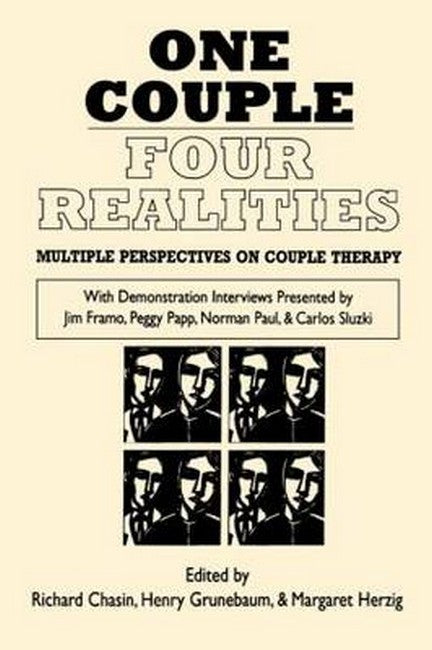
PART I. Background 1. A Multi-theoretical Approach to Couple Therapy: The Harvard Couple Therapy Conference and the Preparation of This Book 2. The Couple: History and Genograms PART II. The Four Demonstration Interviews 3. The Use of Structured Fantasy in Couple Therapy 4. Integrating Families of Origin into Couple Therapy 5. Enhancing Empathy in Couples: A Transgenerational Approach 6. Systemic Blueprints in a Therapeutic Conversation PART III. Treatment Approaches in Couples 7. Future Perfect, Past Perfect: A Positive Approach to Opening Couple Therapy 8. A Systemic Perspective on the Opening of a Therapeutic Encounter 9. Object Relations and the Couple: Separation-Individuation, Intimacy, and Marriage 10. From Discourse to Dialogue: The Power of Fairness in Therapy with Couples 11. Treating Communication Problems from a Behavioral Perspective ART IV. Issues in Couple Therapy 12. Women in Couples: How Their Experience of Relationships Differs from Men's 13. Therapists' Fantasies in Working with Couples: The Unstable Triad 14. Navigating Among the Theories: An Eclectic Approach to Couple Therapy 15. Toward a Theory of Marital Bonds, or Why Do People Stay Married? PART V. Retrospective Reports by the Couple and the Editors 16. Introduction to the Retrospective Reports The Editors 17. One Day Later: A Report from the Couple 18. Six Months Later: A Follow-Up Interview 19. Six Years Later: A Report from the Couple
By far! The best available demonstration of the multiple perspectives of couples therapy. --Phil Striegel, The University of Iowa, Iowa City I've used the book several times for a course in Marital Therapy (I taught the same course two times). What I like about it is that it gives a breadth of different schools of therapy. While looking at the same case, the authors give their comments on the process at the same time. I also really appreciate the ethical concerns raised by this book, even to the point of the authors saying they might not do it again. This type of self critical, self reflexive perspective is very beneficial. My students have found it to be very useful and very understandable, particularly the chapter on contextual therapy. --Jerry Gale, Ph.D., University of Georgia The book's strength is being able to communicate similarities and differences between different theoretical models in conceptualizing behavior. It shows different interpretations of the same basic concepts which helps students understand theories better. The book is extremely well written and I found it to be very useful on the graduate school level. --Margaret Crosbie-Burnett, Ph.D., University of Miami Now, from that intellectual summit of couples' treatment--the annual Harvard Couple Therapy Conference--has come this remarkable Rashomon-like narrative. One Couple, Four Realities is a bit of a clinical thriller: sophisticated, ever and ever more revealing, and thoroughly absorbing throughout.'' --Maggie Scarf, author of Intimate Partners Startling and dramatic! These were my reactions to reading these reports by four therapists who consulted with the same couple. This volume makes vividly and undeniably clear how radically different these therapists are. In addition, comments by a number of other therapists document starkly differing perspectives about the same clinical material. Further, the comments of the clients themselves immediately after the consultations, and again after 6 months and 6 years, convey distinctive perceptions and sobering, surprising, afterthoughts about the meaning of these consultations for them and their families of origin. Finally the editors conclude with badly needed, thought-provoking reflections on the ethics of using demonstration interviews and tapes for the teaching of therapy. This volume should and will stimulate challenging debate not only among therapists, but also among training program directors, and, all who participate in demonstration interviews, including the couples and families themselves.'' --Lyman C. Wynne, M.D., Ph.D., author of Systems Consultation Here is surely a book for the constructivist age! A fascinating study of multiple perspectives....Most provocative and intriguing is the couple's own feedback on the experience at three points in their later lives....This book is unique for the multiplicity of perspectives provided on the same family across points of view and through time. It will make you rethink your own caseload....'' --Monica McGoldrick, M.S.W., author of Ethnicity and Family Therapy I've used this book several times for a course in Marital Therapy. What I like about it is that it gives a breadth of different schools of therapy. While looking at the same case, the authors give their comments on the process at the same time. I also really appreciate the ethical concerns raised by this book....This type of self critical, self reflexive perspective is very beneficial. My students have found it to be very useful and very understandable, particularly the chapter on contextual therapy. --Jerry Gale, Ph.D., University of Georgia The book's strength is being able to communicate similarities and differences between different theoretical models in conceptualizing behavior. It shows different interpretations of the same basic concepts which helps students understand theories better. The book is extremely well written and I found it to be very useful on the graduate school level. --Margaret Crosbie-Burnett, University of Miami - Stimulating...would clearly enhance any advanced course on marital and family therapy from a practice, research, or training perspective. --Contemporary Psychology, 3/3/1992