
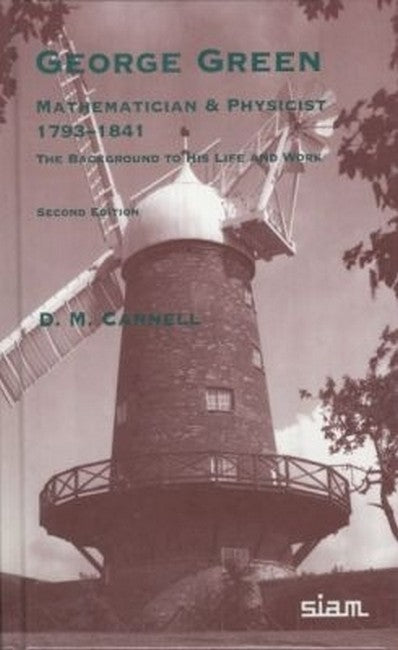
List of Illustrations Preface to the Second Edition Preface Acknowledgements Foreword Introduction In Memoriam: Mary Cannell Chapter 1: Family Background Chapter 2: George Green's Education Chapter 3: Cambridge Interlude Chapter 4: Bromley House Library and the Essay of 1828 Chapter 5: Sir Edward Bromhead Chapter 6: The Publication of George Green's Further Investigations Chapter 7: An Undergraduate at Cambridge Chapter 8: A Fellowship at Caius College Chapter 9: George Green's Family Chapter 10: William Thomson and the Rediscovery of the Essay of 1828 Chapter 11: 'Honour in His Own Country' Appendix I: The Mathematics of George Green by M. C. Thornley, formerly of the Mathematics Department, Nottingham Polytechnic Appendix II: Mathematical Papers of George Green Appendix IIIa: Account by William Tomlin, Esq.: 'Memoir of George Green, Esq.' Appendix IIIb: Account by Sir E. Ffrench Bromhead Appendix IVa: Green Family Tree Appendix IVb: Butler Family Tree Appendix IVc: Smith Family Tree Appendix IVd: Tomlin Family Tree Appendix Va: Time Chart of British Mathematicians and Men of Science Appendix Vb: Time Chart of Other Mathematicians and Men of Science Appendix VIa: The Greening of Quantum Field Theory: George and I by Professor Julian Schwinger Appendix VIb: Homage to George Green: How Physics Looked in the Nineteen-Forties by Professor Freeman Dyson Notes References I: Biographical References II: Scientific Index.

Request Academic Copy
Please copy the ISBN for submitting review copy form
Description
'Mary Cannell's fascinating life of George Green provides us with clues as to how this miller of Nottingham, with only four terms of schooling, was the first to obtain Gauss's integral theorem. It also leaves many mysteries, such as why Green was quickly forgotten in both Nottingham and Cambridge (thus his essay of 1828 had to be rediscovered by Kelvin) and whether more will ever be learned to explain his scientific work. New material documents the critical role Green's functions continue to play in mathematical physics.' Robert E. O'Malley, Jr, University of Washington