
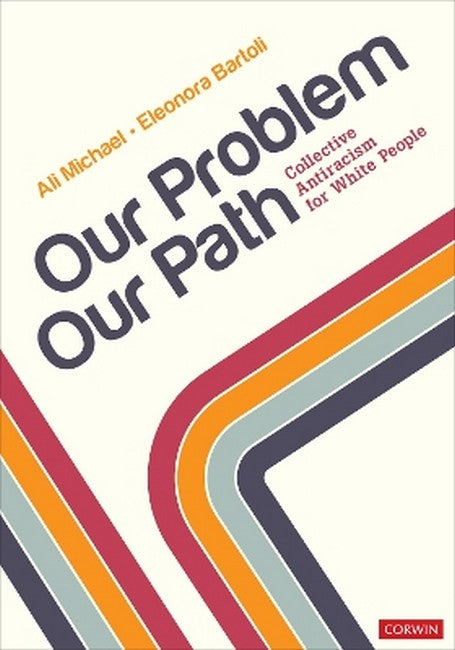
As the Director of the Race Institute for K-12 Educators, Ali Michael, Ph.D. works with schools and organizations across the country to help make research on race, Whiteness, and education more accessible and relevant to educators. Ali is the author of Raising Race Questions: Whiteness, Inquiry and Education, winner of the 2017 Society of Professors of Education Outstanding Book Award. As a member of a multiracial editorial team, she has co-edited The Guide for White Women who Teach Black Boys, Teaching Beautiful and Brilliant Black Girls, and Everyday White People Confront Racial and Social Injustice: 15 Stories. With her colleague Toni Graves Williamson, Ali adapted Robin DiAngelo's White Fragility for a Young Adult audience. Ali sits on the editorial board of the journal Whiteness and Education. Her article, What do White Children Need to Know About Race?, co-authored with Dr. Eleonora Bartoli in Independent Schools Magazine, won the Association and Media Publishing Gold Award for Best Feature Article in 2014. When she is not writing, speaking, or training, Ali is striving to be an anti-racist co-parent to two amazing kids. Her writing and speeches are available at alimichael.org. Eleonora Bartoli, Ph.D., is a consultant and licensed psychologist, specializing in trauma, resilience-building, and multicultural/social justice counseling. She earned her Ph.D. in Psychology: Human Development/Mental Health Research from the University of Chicago in 2001. After receiving her clinical license in 2005, she opened a small independent practice, which she has held since. After 15 years in academia (12 of those years as the director of a Masters in counseling program), she became a full-time consultant. Her mission is to share the tools of counseling and psychology in support of social justice work. Throughout her career, Dr. Bartoli has held leadership positions in professional organizations at both the state and national levels. She has also presented at numerous conferences and is the author of a number of publications focused on multicultural counseling competence, white racial socialization, and the integration of social justice principles in evidence-based counseling practices (please see her website, dreleonorabartoli.com, for details). Dr. Bartoli has been the recipient of academic awards, including the Lindback Foundation Award for Distinguished Teaching and the Provost Award for Outstanding Advising and Mentoring. The Gillem-Bartoli Alum Award for Contributions to Social Justice was established to honor hers and a colleague's contributions in their role as activist-scholars within academia. In all her work, Dr. Bartoli integrates an understanding of neuroscience, focusing on how it informs symptom development as well as healing and resilience-building strategies.

Request Academic Copy
Please copy the ISBN for submitting review copy form
Description
Publisher's Acknowledgments About the Authors Part 1: Beginnings Prologue About This Book Ali's Journey Eleonora's Journey Part 2: Seeing Ourselves Clearly in the Here and Now Chapter 1: Racism Is a White Person's Problem Internal Work: Antiracism in a Human Body Chapter 2: Myths of White Supremacy Internal Work: To Act, You Must Pause Chapter 3: What White People Learn About Race Internal Work: Antidotes to White Supremacist Priming Chapter 4: Now We Know What Not to Say . . . What Do We Say? Internal Work: Empathy Is Our Superpower Chapter 5: Can White Antiracist People Feel Proud of Being White? Internal Work: Don't Get Stuck in Stereotype Threat Chapter 6: Who Is White . . . and Why? Internal Work: But It's Not Fair! Part 3: Who Will We Be as the Racial Hierarchy Falls? Chapter 7: Taking Feedback and Using It Wisely Internal Work: On Moral Injury and Racial Competence Chapter 8: Talking to Other White People About Race Internal Work: Healing Is Essential to Antiracist Practice Chapter 9: Creating and Sustaining White Antiracist Learning Spaces Internal Work: To Prepare for Antiracist Action, You Must Train for Courage Chapter 10: Taking Action Appendix A: Common Unproductive, Possibly Biased Behaviors of Some/Many White People That Perpetuate Racist Dynamics and Structural Racism Appendix B: Examples of White Group-Level Behaviors/Privilege References Index