
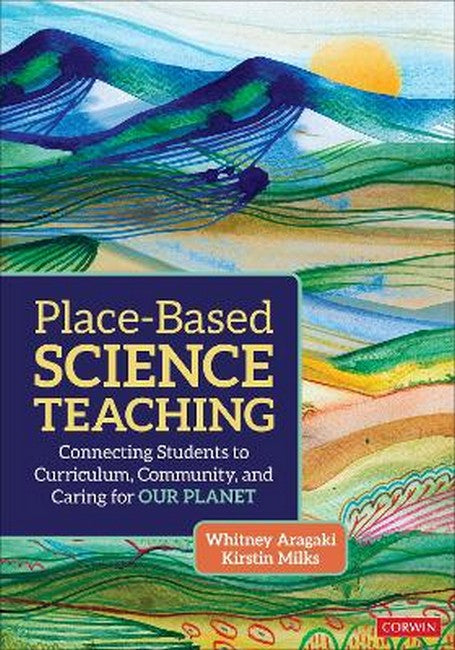
Place-Based Science Teaching

CORWIN PRESS INC.ISBN: 9781071973684

Connecting Students to Curriculum, Community, and Caring for Our Planet

Price:
Sale price$82.99
Stock:
Temporarily out of stock. Order now & we'll deliver when available

By Whitney Aragaki, Kirstin Milks
Imprint:
CORWIN PRESS INC.
Release Date:
Format:
PAPERBACK
Dimensions:
254 x 177 mm
Weight:
580 g
Pages:
272

Request Academic Copy

Button Actions

Please copy the ISBN for submitting review copy form

Description

Whitney Aragaki is an educator, parent, and learner from Hilo, Hawai?i. She supports students to learn through a lens of abundance that honors place, people and cultures. Her teaching focuses around conversations, practices and systems that sustain the intimate inter-relationship of public education, community and environment. Whitney is a fifth-generation Hawai?i Island resident of Japanese ancestry. She is the daughter of two educators, and was a student in her mother's biology class. She currently serves as a high school science teacher at her alma mater, Waiakea High School and as a Professor of Practice and Faculty Lead at Reach University. Her two children also thrive in this supportive public-school ecosystem. Whitney has a Bachelor of Arts in biology from Swarthmore College, a Master of Science in Tropical Conservation Biology and Environmental Science from the University of Hawai'i at Hilo, and a Doctor of Philosophy in Education from the University of Hawai'i at Manoa College of Education. Whitney, a National Board Certified Teacher, is the 2022 Hawai?i State Teacher of the Year and National Teacher of the Year Finalist. She is a 2021 Presidential Awardee for Excellence in Math and Science Teaching and a 2023 Obama Foundation USA Leader. Kirstin J. Milks teaches AP Biology and introductory science at Bloomington High School South in Bloomington, Indiana, where she also serves as a STEM team coach and mentor. Kirstin loves collaborating with students and community members to learn together in inclusive and responsive environments, as well as supporting and making public the work of teaching and learning-all with the goal of helping youth build a just and sustainable world. A graduate of Stanford University's Schools of Medicine (PhD) and Education (MA), she is a National Board Certified Teacher, a Presidential Awardee for Excellence in Math and Science Teaching, a Lilly Teacher Creativity Fellow, the 2025 president of the National Association of Biology Teachers, her Girl Scout council's Leader of the Year, and a Senior Fellow at the Knowles Teacher Initiative. She's worked with organizations including the MacArthur Foundation, the Carnegie Foundation, the National Science Foundation, the College Board, SXSW EDU, Educating for Environmental Change, and schools across the country to envision, engineer, and enact the future of education, with a focus on humane and socially-responsive science teaching. When she's not teaching or volunteering with Girl Scouts, Kirstin enjoys visiting the local library with her family, practicing all-ages taekwondo, and singing along at top volume to local radio.
Contributors Preface Why Place-Based Teaching? Our Goals for This Book How to Use This Book Features of the Book Self-Awareness, Personally and Professionally Author Positionality Uncovering Your Positionality A Few Notes on Language Land Acknowledgment Acknowledgments About the Authors Chapter 1: A First Look at Place-Based Teaching Practices Introduction to the Work What Is Place-Based Teaching? Why Is Place-Based Science Teaching Effective and Important? Four Questions of Place-Based Science Teaching What Inspired the Place-Based Science Teaching Framework? Wait, Is Place-Based Learning Another Way to Say Project-Based Learning? (K)new Invitations Knowledge Innovation Belonging for Students Learning and Community for All Building Belonging in Science Class Acknowledging Land How Are Land Acknowledgments a Good Opportunity for Exercising Place-Based Science Concepts and Learning? Sociocultural Features of Helpful Land Acknowledgments Land Acknowledgments Are Best as a Process of Learning E lu'u hou i ka wai Reflection Questions Chapter 2: Where Are You? Noticing Place, Wherever You Are Getting Started: Uncovering Specifics of Place BioBlitzes and Square of Life: Documenting Place in Class More Examples of Where in Place Sit Spots: Individualized Invitations to Place Field Experiences in Kirstin's Small Midwestern City Kilo Exploring Connection to Place Stories Across Our Places: How Teachers and Students Ask, "Where Are We?" Reflection Questions Chapter 3: When Are You? Crosscutting Concepts: Investigating "When Through Authentic Features of Science and Engineering" Exploring Scales of Time Intertwined Histories, Intertwined Science What's "The Trouble With Wilderness?" Exploring Ecosystem Services Caretakers of Our Land, Past and Future Stories Across Our Places: How Teachers and Students Ask, "When Are We? Reflection Questions Chapter 4: Who Are You? How Are Place and Identity Linked? Strengthening Self-Awareness Strategies for Supporting Student Identity Exploration Through Place Leveraging Informal Conversations With Students Connecting With Family as a Means of Connecting With Self and Place Learning From Elders About Their Experiences of Place Celebrating Local Diversity of Place and of People Stories Across Our Places: How Teachers and Students Ask, "Who Am I?" Reflection Questions Chapter 5: Who Are We Together? Developing Science Curriculum to Reflect Student Experiences and Relationships Combating Place-Based Injustice With Action Growing Justice Education: Starting With the Teacher Belonging as Action Classroom as Place Student and Family Relationships Student and Place Relationships: Safe, Brave, and Accountable Spaces Teaching Beyond the Classroom Participatory Science Place- and Project-Based Learning: Connecting Global Challenges to Local Action Connecting Big Problems to Local Solutions It's OK to Start Small Stories Across Our Places: How Teachers and Students Ask, "Who Are We Together?" Reflection Questions Chapter 6: Virtual Spaces and Our Places (Re)defining Place Place in Virtual Space Science in Virtual Terms Science in Virtual Place Access and Equity in Virtual Places Inquiry and Privilege Artifacts and Access Identity, Safety, and Belonging Framing a Digital Environment With Four Questions Where Are You in the Digital Environment? When Are You in the Digital Environment? Who Are You in the Digital Environment? Who Are We Together in the Digital Environment? Digital Equity and Belonging Reflection Questions Chapter 7: Place-Based Teaching for Sustainable Futures Justice-Ready Futures A VUCA Forecast Joy and Justice AI-Ready Futures What Does AI Say About This? Where Does AI Fall Short? Refuge-Ready Futures Teaching Place Away From Home (K)new Beginnings Climate-Ready Futures The Climate Gap Place-Based and Future-Forward (Be)coming Home Final Words From Whitney References Index

Place-Based Science Teaching ignites a powerful vision for science education-rooted in local context, real-world relevance, and student curiosity. Written by National Board Certified Teachers, it's packed with classroom-ready ideas and inspiring stories that show how reimagining the learning journey can spark deeper learning and lasting impact. A must-read for educators ready to transform science teaching! -- Peggy Brookins * Arlington, VA * In our increasingly indoor-, media-, and technology-focused world, reconnecting young people to the environment has never been more important. This book is both a catalyst and a passionate practicum to do just that: grounding science education in the natural and cultural landscapes of home. -- Thor Hanson * Friday Harbor, WA * Place-Based Science Teaching offers a transformative approach to education. By deeply connecting students to their curriculum, community, and planet, this insightful guide showcases the authors' critical analysis and tremendous creativity. The book's practical and inspiring strategies empower educators to nurture student agency and a much-needed sense of care for our world, giving me great hope for the future of science teaching. -- David Upegui * North Providence, RI * Everything I know about place-based learning, I learned from Whitney Aragaki. She opened my eyes to a world in which honoring place, histories, and personal context is centered and celebrated with humility and humanity. For educators feeling the isolation that technology can sometimes create, this reading will inspire new possibilities- reimagining online spaces with a place-based approach that celebrates community and honors life experiences. -- Starian Porchia * Anna, TX * This powerful resource provides a multitude of entry points and classroom-tested strategies for place-based science teaching. Not only a resource guide, this book also challenges the traditional notions that science teaching and learning are neutral. A must-read for social justice-oriented science teachers! -- Kimi Waite * Los Angeles, CA * As a teacher who strives to connect my students with their world, this book is extremely useful. It provides ways for my students to learn science through authentic interactions with nature and people in our community. -- Amanda Clapp * Sylva, NC * This book provides clear and convincing evidence of how place-based learning helps students develop a deep knowledge of local environments and their relationships with them, strengthen their ties to the community, and foster the agency to solve real-world problems. Each chapter provides powerful frameworks, lesson-ready tools, and richly detailed cases of science teachers around the country who are engaging their young learners in diverse and holistic forms of placed-based inquiry. -- Mark Windschitl * Seattle, WA * A well thought out book that brings place to its rightful spot in learning by looking at what and who was there, with an eye to honor those before while maintaining it for the present and beyond. -- Melissa Hockaday * Cary, NC * Place-based science immerses any science class in real-world applications for students. No longer will students ask, 'When am I ever going to use this,' since they will be using their (k)newfound knowledge wherever and whenever they are. -- Deanna McClung * Elkhorn, WI * Aragaki and Milks invite educators to redraw their maps-not just around textbooks and test scores, but around the texture of home as well. This book will inspire teachers, transform pedagogy, and have a profound impact on students' lives. -- Bryan A. Brown * Stanford, CA * As an educator of color, I have long searched for authentic resources that center culture, community, and justice in ways that go beyond performative land acknowledgments or one-off lessons. Place-Based Science Teaching: Connecting Students to Curriculum, Community, and Caring for Our Planet is a call to action and a guide for educators to lead with culture, justice, and humanity at the heart of science. It invites us to reclaim science as something that lives in our communities, in our stories, and in our relationships to place. -- Leena Bakshi McLean * Honolulu, HI * An essential, resource-abundant guide for more meaningful, relational, and authentic place-based science education. Nurture your science instruction through grounding, spirit, accountability, intentionality, and importantly: criticality. -- Jerad Koepp * Rainier, WA * Aragaki and Milks offer a powerful case for place-based learning as an essential tool for navigating today's polycrisis. By honoring identities, histories, and lived experiences, they invite educators and students into inquiry around a more expansive view of knowledge. This book is both a toolkit and an inspiration, encouraging reflection on our relationship with place and affirming our stories as critical testimonies. It is capable of sparking and sustaining action for a more joyful and just future. -- Jothsna Harris * Twin Cities, MN * The power of this book is felt from its very first sentence, posed as a question to unlock the power within us: What if the way forward is just under our feet? This question encourages educators to think holistically about how we can expand our connection and humanity through place-based science practices. This book is the way forward, recommitting us to lifelong learning through curiosity, wonder, and awe of the natural world! -- Juliana Urtubey * Phoenix, AZ * The work I do every day is founded in place-based teaching and learning, and few people have taught me more about how to do that well than Whitney Aragaki. Her vision for education rooted in place is both revolutionary and anchored in ancient wisdom. Aragaki and Milks have written the essential guide to the future of place-based education, which is truly the heartbeat of any valuable education at all. -- Ashley Lamb-Sinclair * Louisville, KY * Aragaki and Milks root science education in the richness of local context and community wisdom. Their approach not only deepens student engagement and builds critical problem-solving skills but also rekindles the joy and purpose that initially drew many of us to teaching. Grounded in decades of classroom experience and research, they provide educators with the tools to cultivate students who can meaningfully connect science learning to the world they will inherit and shape. -- Kristin Cook * Louisville, KY *

You may also like

Recently viewed