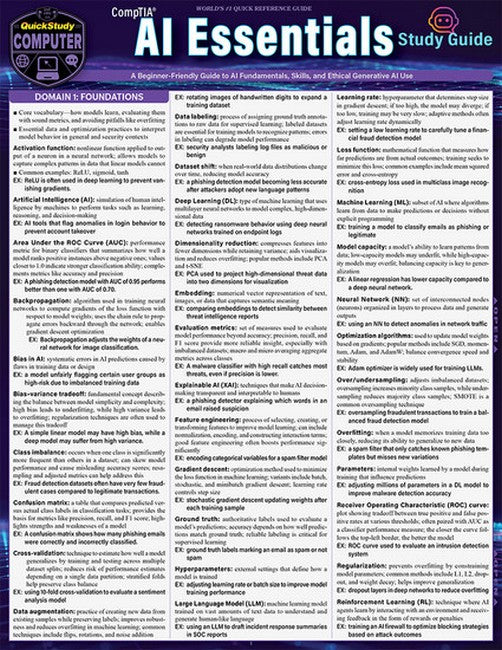
- Definitions & Explanations with Examples within each Domain
- Domain 1: Foundations
- Core vocabulary—how models learn, evaluating them with sound metrics, and avoiding pitfalls like overfitting
- Essential data and optimization practices to interpret model behavior in general and security contexts
- Domain 2: Generative AI Frontiers
- Generative AI systems; LLMs, diffusion models, GANs, and multimodal systems and the parameters and techniques that shape their outputs
- Security and trust concerns; fine-tuning approaches and responsible alignment practices
- Insight into how GenAI is built, its risks and frontiers
- Domain 3: Prompt Engineering & Security
- Prompt engineering (designing inputs to guide GenAI systems)
- Prompting strategies and techniques for chaining prompts and managing context windows
- Security issues and mitigation approaches
- Controlling outputs and understanding vulnerabilities to engineer safer and more effective AI interactions
- Domain 4: AI-Enhanced SIEM
- How AI enhances Security and Information Event Management (SIEM) systems
- Foundations of log management, data normalization, and event correlation; AI-driven anomaly detection, UEBA, and risk scoring to detect threats more effectively
- How SOAR and playbooks automate response; threat intelligence and ATT&CK mapping enrich context; and explainability, feedback loops, and data privacy concerns ensure SIEM remains trustworthy and effective in modern SOC environments
- Domain 5: AI in IAM
- How AI enhances Identity and Access Management (IAM) systems
- AI-driven methods (adaptive and behavioral) for authentication and advanced access controls
- How AI improves fraud detection, insider threat monitoring, identity proofing, and continuous authentication
- Governance and compliance issues to ensure IAM systems remain secure, transparent, and aligned with regulatory standards
- Domain 6: Securing AI Systems & Models
- Security of AI models and systems across their lifecycle
- Adversarial threats and defensive strategies
- Operational practices like secure deployment, drift monitoring, red teaming, and MLOps security; governance frameworks like MITRE ATLAS, OWASP Top 10 for LLM Applications (LLM Top 10); and responsible disclosure
- How to secure AI systems from both technical and governance perspectives