
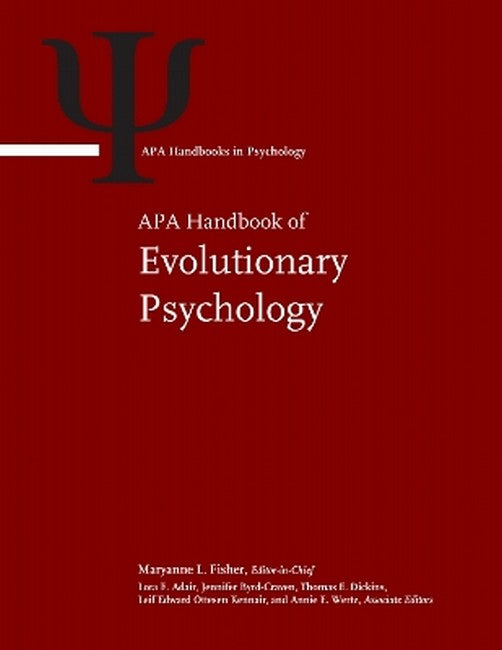
Maryanne L. Fisher, PhD, is a professor in the Department of Psychology at Saint Mary's University, where she holds the inaugural Santamarian Research Chair for the Faculty of Science. She also serves as an affiliate faculty member of the Kinsey Institute in Bloomington, Indiana. She has produced over 200 peer-reviewed publications, primarily on the evolutionary foundations of human interpersonal relationships, with a focus on female intrasexual competition, physical attractiveness, and mating strategies. Dr. Fisher is an award-winning teacher and student mentor. In 2023, she received the Queen Elizabeth II's Platinum Jubilee Medal. ln 2019, she was named a Fellow of the NorthEastern Evolutionary Psychology Society. For more information, visit https://www.maryannefisher.ca Lora E. Adair, PhD, is a senior lecturer in psychology and deputy director of the Centre for Culture and Evolution at Brunel University of London. She leads The Adair Lab which, through the contribution of her outstanding PhD, MSc, and BSc students and research assistants, produces cutting-edge, community-engaged research on women's health and well-being. Dr. Adair's primary scientific contributions include combining feminist and evolutionary models to understand the relationship between women, and gender diverse people, and their social world. For updates on her research, visit https://www.brunel.ac.uk/people/lora-adair and @loraadair.bsky.social. Jennifer Byrd-Craven, PhD, is a professor of psychology at Oklahoma State University, where she cofounded the Oklahoma Center for Evolutionary Analysis (OCEAN), which promotes interdisciplinary training in the evolutionary social sciences, and directs the Psychobiology Lab. She also teaches courses in behavioral neuroendocrinology, developmental psychobiology, and evolutionary psychology, and serves as director of the Experimental Psychology graduate program. Her research explores how a variety of social and developmental contexts influence neuroendocrine responses with a focus on sex differences and health outcomes. For current information about her research, visit https://theocean.mystrikingly.com and https://byrd-cravenpsychobiologylab.mystrikingly.com Thomas E. Dickins, PhD, is a professor of behavioral science at the University of West London. His active research interests are in evolutionary theory and its application within the behavioral sciences. He has conducted a wide range of empirical work, including projects on life history approaches to fertility scheduling in Western women, various aspects of inequality, and normative behavior, as well as work on seabirds, investigating their parental behaviors. Dr. Dickins cofounded the European Human Behavior and Evolution Association in 2006 and has served as a prior Editor-in-Chief of the previously named Journal of Evolutionary Psychology (now Culture and Evolution). For more information about his activities and publications, visit http://tomdickins.net/ Leif Edward Ottesen Kennair, PhD, is a specialist in clinical adult psychology and professor of personality psychology at the Norwegian University of Science and Technology (NTNU), as well as a supervisor of cognitive-behavioral therapy. His research includes the application of sexual strategies theory to explore topics such as jealousy, regret, sexual harassment, sexual development, sexual orientation, mate preferences, and the use of dating apps. He currently serves as Editor-in-Chief of the Scandinavian Journal of Psychology. He is an elected member of the Royal Norwegian Society of Sciences and Letters and an appointee of the Norwegian Cabinet Committee on Women's Health. Annie E. Wertz, PhD, is a professor of psychology at the University of California, Santa Barbara, where she leads the Lab for Infant Learning and Cognition (LILAC), and is a core faculty member in the Center for Evolutionary Psychology. Her research investigates cognitive development from an evolutionary perspective, with a focus on how infants and young children learn about the natural world. Her work has won several awards, including the Human Behavior and Evolution Society's Margo Wilson Award in 2021 and the inaugural Don Symons Adaptationism Award in 2023. Visit https://lilac.psych.ucsb.edu/ for more information about her research.

Request Academic Copy
Please copy the ISBN for submitting review copy form
Description
Volume 1. Foundations, Cognition, Family, and Group Living Foreword David M. Buss Introduction to the APA Handbook of Evolutionary Psychology Maryanne L. Fisher Part I. Foundations Chapter 1. Foundations of Evolutionary Behavioral Science Thomas E. Dickins and Maryanne L. Fisher Chapter 2. Natural Selection and Adaptation Yvan I. Russell Chapter 3. Sexual Selection Laura K. Weir Chapter 4. Three Paths Through the Levels of Selection DB Krupp Chapter 5. Life History Theory: A Heuristic for Understanding Development, Reproduction and Health Across the Lifespan and Generations David A. Coall, Rebecca Sear, Temitope Bolomope, and James S. Chisholm Chapter 6. Parental Investment Nafi Mohammad Ali and Mary K. Shenk Chapter 7. Comparative Approaches Chris Pawson Chapter 8. The Gene's-Eye View of Culture Nicolas Baumard, Jean-Baptiste Andre, Daniel Nettle, Leo Fitouchi, and Thom Scott-Philipps Chapter 9. Developmental Systems Theory and Evolutionary Psychology Thomas E. Dickins Chapter 10. Frameworks, Models, and Idealizations Andrew Goldfinch Chapter 11. Intuitive Cognitive Biases Against Evolutionary Psychology Laurence Fiddick Part II. Cognition Chapter 12. Cognitive Architecture for Mating Daniel Conroy-Beam and Benjamin Gelbart Chapter 13. The Evolved Cognitive Architecture of Groups David Pietraszewski Chapter 14. How Do Humans Think About Family? Perspectives From Developmental Psychology Christina M. Steele and Ashley J. Thomas Chapter 15. Adaptive Challenges for Cognition Underlying Cultural Learning Cristina Moya and Patricio Cruz y Celis Peniche Chapter 16. Cognitive Bias Andreas Wilke and Rui Mata Chapter 17. Cognitive Development Annie E. Wertz Part III. Family Chapter 18. Childhood Yitong Wang and Tanya MacGillivray Chapter 19. Kinship Mark V. Flinn and Heather Habecker Chapter 20. Parent-Child Relationships and Conflict Catherine A. Salmon and Jessica A. Hehman Chapter 21. Cooperation and Conflict in Kin Olympia Louise Kathleen Campbell, Qiao-Qiao He, and Ruth Mace Chapter 22. Sibling Resemblance and Relationships: Through an Evolutionary Lens Nancy L. Segal, Joseph L. Nedelec, and Catherine Salmon Part IV. Group Living Chapter 23. Justice-Making Institutions Daniel Sznycer and Hongming Chen Chapter 24. The Evolutionary Psychology of Human Social Hierarchies Harrison M. Miller and Jon K. Maner Chapter 25. Punishment: A Force for Both Good and Bad Pat Barclay Chapter 26. An Evolutionary Understanding of Friendship Jaimie A. Krems and Jennifer Byrd-Craven Volume 2. Mating, Personality, Emotions, and Applications Part I. Mating Psychology Chapter 1. Beyond the Darwin-Bateman-Trivers Paradigm: Reconsidering Sexual Conflict and Parental Investment Theory in Contemporary Ecologies Renata Pereira Defelipe, Mauro Silva Junior, Lilian Cristina Luchesi, Maria Luiza Rodrigues Sampaio de Souza, and Justin K. Mogilski Chapter 2. Sex, Gender, and Mating T. Joel Wade, Karla Kenny, and Lora E. Adair Chapter 3. Critical Perspectives on Sex/Gender and Mating Rebecca Burch, Lora E. Adair, and Francisco R. Gomez Jimenez Chapter 4. The Sexually Antagonistic Gene Hypothesis and the Evolution of Male Androphilia Paul L. Vasey, Scott W. Semenyna, and Francisco R. Gomez Jimenez Chapter 5. Evolutionary Psychological Explorations Into Human Intrasexual Mating Competition Tania Reynolds, Steven Arnocky, and Maryanne L. Fisher Chapter 6. Evolutionary Forces Governing Attraction and Self-Promotion: The Process of Intersexual Selection Steven Arnocky, Tania Reynolds, Mitch Brown, Adam C. Davis, and Maryanne L. Fisher Chapter 7. Intimate Partner Violence, Stalking, and Homicide Madeleine K. Meehan and Todd K. Shackelford Part II. Personality and Individual Differences Chapter 8. Trait-Covariation, Behavioral Genetics, and Life History Theory Thomas H. Kleppesto and Brandon Zietsch Chapter 9. The Dark Triad Traits in the Light of Life History Theory Lennart Freyth, Evita March, Bruno Bonfa-Araujo, and Peter K. Jonason Chapter 10. Evolutionary Perspectives on Sociosexual Orientations Steven W. Gangestad and Tran Dinh Part III. Emotions Chapter 11. The Structure and Function of Emotions: Emotions as Coordinating Mechanisms Jacqueline Nolly, Elias Acevedo, David M.G. Lewis, and Laith Al-Shawaf Chapter 12. "Could Have, Would Have, Should Have": Is Regret a Human Adaptation? Mons Bendixen, Marius Stavang, and Trond Viggo Grontvedt Chapter 13. Evolutionary Approaches to Anxiety and Related Disorders Dan J. Stein Chapter 14. Mental Disorders: Is Sustained Negative Emotional Processing Adaptive? Leif Edward Ottesen Kennair Part IV. Applications Chapter 15. Evolutionary Industrial/Organizational Psychology: Working With Human Nature Mark van Vugt, Carter Vespi, and Stephen M. Colarelli Chapter 16. Applications of Evolutionary Psychology to Economics C. Monica Capra and Paul H. Rubin Chapter 17. Political Science Rose McDermott Chapter 18. Law and Legal Processes Morris B. Hoffman Chapter 19. Intrasexual Competition and Consumer Responses: A Review of Relevant Articles With Future-Focused Forecasts Tobias Otterbring, Lynn K.L. Tan, and Michal Folwarczny Chapter 20. The Rise of Evolutionary Nudging: Applications for Environmental Sustainability Hidenori Komatsu Chapter 21. Literary Studies Ania Grant Chapter 22. Adaptive Evolution of Artistic Propensities: A Proposal for Evolutionary Artisticology Marco Antonio Correa Varella, Katarzyna Galasinska, and Zuzana Sterbova Part V. Closing Thoughts Chapter 23. Conclusions and Future Directions in Evolutionary Psychology Maryanne L. Fisher, Lora E. Adair, Jennifer Byrd-Craven, Thomas E. Dickins, Leif Edward Ottesen Kennair, and Annie E. Wertz