
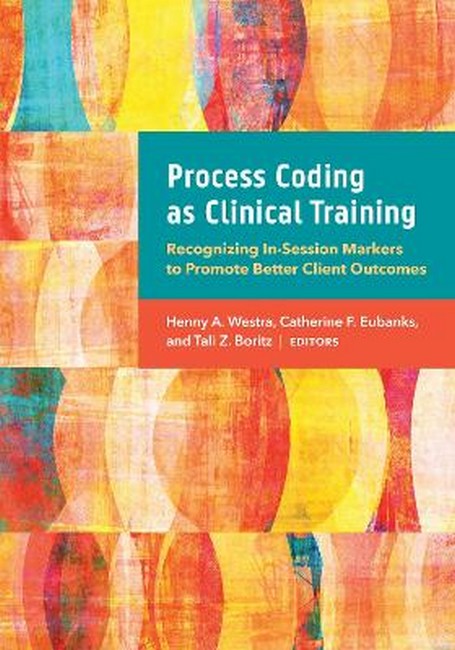
Henny A. Westra, PhD, is professor emeritus in the Department of Psychology at York University in Toronto, Canada. She has held numerous positions over her 30-year career including professor, researcher, workshop presenter and teacher, frontline clinician, and program developer. She has written, published, and presented widely on ambivalence, resistance, anxiety, training and the development of expertise, motivational interviewing, and cognitive behavioral therapy. She is the author of the book Motivational Interviewing in the Treatment of Anxiety and is a principal developer of the Adapted Client Resistance Code (A-CRC), featured in this book alongside numerous other process coding schemes. Catherine F. Eubanks, PhD, is a professor at the Gordon F. Derner School of Psychology at Adelphi University and codirector of the Center for Alliance-Focused Training. She is coauthor of Therapist Performance Under Pressure, and coeditor of Rupture and Repair in Psychotherapy. She was previously an associate editor on the Journal of Consulting and Clinical Psychology and is currently the managing editor of Psychotherapy Research. Tali Z. Boritz, PhD, is an assistant professor in the Department of Psychology at York University in Toronto, Canada. She is a clinical psychologist, researcher, and educator. Her work focuses on psychotherapy process and outcomes, with an emphasis on translating research into practical training tools for clinicians and trainees. She has authored numerous peer-reviewed publications and is coauthor of the book Deliberate Practice in Dialectical Behavior Therapy. She is past president of the North American chapter of the Society for Psychotherapy Research.

Request Academic Copy
Please copy the ISBN for submitting review copy form
Description
Introduction Chapter 1. Leveraging Process Science to Develop Moment-by-Moment Observational Skills Henny A. Westra, Tali Z. Boritz, and Catherine F. Eubanks Part I. Coding Systems Focused on Dyadic Processes Chapter 2. Working Alliance Inventory - Observer Version (WAI-O) Timothy Anderson, Adam O. Horvath, and Mia Schmittenberg Chapter 3. The Rupture Resolution Rating System (3RS) Catherine F. Eubanks, Kaitlin M. Williams, and Dustin Phan Chapter 4. The Motivational Interviewing Skills Code 1.1 and the Adapted Client Resistance Code (A-CRC) Alyssa D. Bartolomeo and Henny A. Westra Chapter 5. Therapeutic Collaboration Coding System (TCCS) Eugenia Ribeiro and Dulce Pinto Chapter 6. Structural Analysis of Social Behavior (SASB) Interpersonal Gestalt Coding Kenneth L. Critchfield, Caroline Ball, Akiva Gornish, Nina L. J. Rose, Hallie R. Goldman, Eleanor G. Harrison, and Julia E. Mackaronis Part II. Coding Systems Focused on Client and/or Therapist Processes Chapter 7. Multicultural Orientation Performance Task (MCO-PT) Emma Freetly Porter and Jesse Owen Chapter 8. The Experiencing Scale (EXP) Antonio Pazo Pires, Ana Daniela Barreto Aleixo, and Carolina Seybert Chapter 9. Classification of Affective-Meaning States (CAMS) Antonio Pascual-Leone and Florencia Cristoffanini Chapter 10. Assimilation of Problematic Experiences Scale (APES) Isabel Basto, Isabel Caro Gabalda, and William B. Stiles Chapter 11. The Innovative Moments Coding System (IMCS) Miguel M. Goncalves, Joao Batista, and Joao Tiago Oliveira Chapter 12. The Narrative-Emotion Process Coding System (NEPCS) Tali Z. Boritz and Lynne Angus Chapter 13. The Pausing Inventory Categorization System (PICS) Heidi M. Levitt, Javier L. Rizo, and Nicholas A. Pierorazio Chapter 14. Client and Therapist Vocal Quality Measures (CVQ & TVQ) Jeanne C. Watson and Hadas Wiseman Chapter 15. A Measure of Expressed Empathy (MEE) Jeanne C. Watson and Signe Hjelen Stige Chapter 16. Resource-Oriented Microprocess Analysis of Patients (ROMA-P) Christoph Flueckiger and Greta Probst Part III. Conclusions and Future Directions Chapter 17. Integrating Process Coding into Clinical Training: Key Considerations and Training Suggestions Tali Z. Boritz, Catherine F. Eubanks, and Henny A. Westra Chapter 18. Conclusions and Future Directions Catherine F. Eubanks, Henny A. Westra, and Tali Z. Boritz