
Amanda A. Uliaszek, PhD, CPsych, is Professor and Program Coordinator in the Graduate Department of Psychological Clinical Science at the University of Toronto. Her research focuses on symptoms, treatment, and stigma related to borderline personality disorder; the dimensional structure of personality pathology and personality functioning; and disability, stigma, and self-advocacy in postsecondary student mental health. Dr. Uliaszek has clinical expertise in dialectical behavior therapy and cognitive-behavioral therapy. Christopher J. Hopwood, PhD, is Professor of Personality Psychology at the University of Zurich, Switzerland. Dr. Hopwood is Associate Editor of the Journal of Personality Assessment and the Journal of Psychopathology and Clinical Science, and Editor-in-Chief of the journal Psychology of HumanaEUR"Animal Intergroup Relations. He is a recipient of the Theodore Millon Grant in Personality Psychology from the American Psychological Foundation, among other honors. Dr. Hopwood's research interests include personality assessment and development, interpersonal processes, psychopathology, and humanaEUR"animal relations.

Request Academic Copy
Please copy the ISBN for submitting review copy form
Description
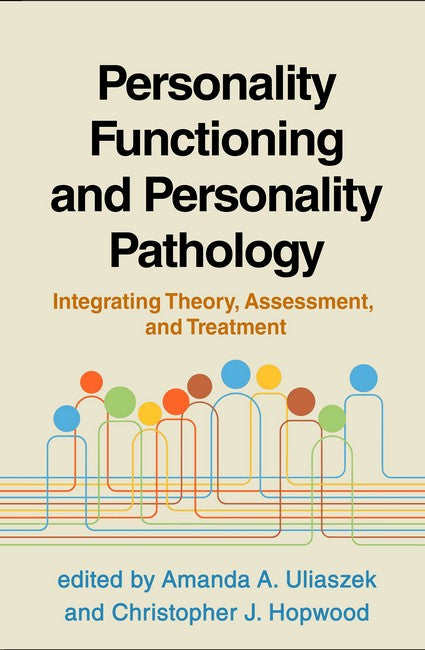
Introduction: Personality Functioning in a Historical Context, Christopher J. Hopwood & Amanda A. Uliaszek I. Theoretical Perspectives in Personality Functioning 1. Personality Functioning as One Thing: A Psychoanalytic Self-Other Perspective, Donna Bender 2. How Does Personality Lead to Psychopathology?: Personality Functioning as Risk for Cybernetic Dysfunction, Colin G. DeYoung 3. Personality Functioning through the Lens of Contemporary Integrative Interpersonal Theory, Aaron L. Pincus & Parandis Pourdehghan 4. A Developmental Perspective on Personality Functioning, Carla Sharp 5. Narrative Identity and Personality Functioning: Storying What It Means to Be a Person, Majse Lind & Kennedy M. Balzen II. Personality Functioning Models of Psychopathology 6. The Computational Architecture of Personality Functioning, Orestis Zavlis, Michael Moutoussis, Tobias Nolte, Patrick Luyten, Peter Fonagy, & Giles Story 7. Incremental Validity of Personality Functioning and Personality Traits: Current Insights and Future Directions, Lennart Kiel & Johannes Zimmerman 8. Personality Dysfunction: Conceptual and Measurement Issues in Diagnosing Personality Pathology, Lee Anna Clark & Carla Sharp 9. HiTOP and Personality Functioning, Isabella Manuel & Holly F. Levin-Aspenson III. Research Methods 10. The Who, What, Why, and How of Personality Functioning Measurement, Amanda A. Uliaszek 11. The Dynamics of Personality Dysfunction across Levels of Time, Michael J. Roche & Audrey L. Stephenson 12. Integrating Dimensional Neurobiology and Personality Psychopathology Frameworks to Understand Personality Functioning and Impairment, Anthony C. Ruocco, Michael Carnovale, & Giuseppe Guerriero IV. Therapeutic Approaches to Personality Functioning 13. Understanding and Treating Personality Functioning in Cognitive-Behavioral Therapy, Shannon Sauer-Zavala, Sarah Cecil, & Caden Maynard 14. Personality Dysfunction in Dialectical Behavior Therapy, Mathew W. Southward, Madeline L. Kushner, Hannah Croom, & Martina Fruhbauerova 15. Using Contemporary Integrative Interpersonal Theory to Understand and Treat Personality Dysfunction, Nicole M. Cain V. Diversity, Equity, and Inclusion in Personality Functioning 16. Cross-Cultural Conceptualization of Personality Functioning, Adam P. Natoli, Caroline F. Carmody, Apryl A. Alexander, Giselle A. Hass, & Suzanne G. Pitama 17. Personality Dysfunction, Stigma, and Diverse Identities, Sarah R. Masland & Laura Furtado Fernandes Conclusion: What We Know, What We Think We Know, and What We Want to Know about Personality Functioning, Amanda A. Uliaszek & Christopher J. Hopwood Index
aEURoeFew topics are as clinically important but conceptually challenging as PF. One could argue that the field has offered little more useful than 'you know it when you see it.' This volume valiantly and successfully takes up the challenge of mapping a pluralistic and contemporary scholarly view on PF. Chapters span basic science to applied treatment, psychometrics to neuroscience. Scientists and practitioners of all stripes will find this book useful for clarifying and furthering their understanding of one of psychopathologyaEUR (TM)s most central and perplexing phenomena.aEUR--Aidan G.C. Wright, PhD, Professor of Psychology and Psychiatry, University of Michigan aEURoeBringing together accessible theoretical overviews, empirical perspectives, and clinical applications, this book makes a significant contribution to the field. Especially compelling is its relevance for clinicians of all orientations--by presenting multiple approaches, it shows how personality functioning (PF) can serve as a common language across models. This volume is essential reading for graduate students, researchers, and practitioners seeking an up-to-date, clinically meaningful account of how dimensional approaches to personality can be translated into clinical practice through the lens of PF.aEUR--Susanne HA?rz-Sagstetter, PhD, Professor of Clinical Psychology and Psychotherapy, Psychologische Hochschule Berlin, Germany -