
Heewon Chang, PhD., serves as Professor and Chair of the PhD in Organizational Program at Eastern University in the USA. When she began her academic career as an assistant professor of education, her teaching focused on undergraduate and Master's students. For the last 20 years, her teaching focus has shifted to PhD students. She has taught courses in qualitative research methods, program evaluation, educational leadership, systems thinking, and organizational and systematic justice and equity. She has also supervised over 30 doctoral dissertations to completion. In addition to teaching and dissertation supervision, she founded and had served on two academic journals as their founding Editor-in-Chief for over 20 years. One of them, International Journal of Multicultural Education, has been continuously publishing since 2007. As an author, she has published six books. Her dissertation research became her first book, Adolescent Life and Ethos: An Ethnography of a US High School (1992). Over the last two decades, she has dedicated her time to advancing autoethnography as a social science qualitative research method. Her solo and collaborative efforts have resulted in several articles, book chapters, and books such as Autoethnography as Method (2008); Spirituality in Higher Education: Autoethnographies (2011); Collaborative Autoethnography (2013); and Transformative Autoethnography for Practitioners (2020). Her teaching and publishing efforts reflect the pedagogical approach of collaboration and mentoring. Through her collaborative work, she models how to listen attentively, learn with humility, and support others' success genuinely. Her recent accomplishment includes bringing over 40 students, alumni, and faculty from her PhD in Organizational Leadership program to create a collection of essays on leadership and followership. The book, Leadership and Followership for 100 Years: Lessons from Practice, Research, & Reflection (2025), resulted from this community effort. Jeff Logan, PhD, is a faculty member at the Southern Alberta Institute of Technology. His doctoral research explored the role of humor in Indigenous leadership across multiple industry sectors. He teaches in the areas of Indigenous Studies, Research Methods, and Communication Studies. His teaching has allowed him to work in Canada, Russia, China, South Korea, and the United States. In addition to his postsecondary work, he collaborates closely with First Nations and Metis communities, contributing to program reviews, organizational assessments, strategic planning initiatives, and leadership development. He also serves in leadership roles within the nonprofit sector, particularly supporting newcomers to Canada. Dr. Logan's academic research focuses on humor studies, informed by his earlier training in anthropology and linguistics. He has also dabbled in the humor field as a standup comedian, emcee, illustrator, and cartoonist. Raised by two first-generation college graduates, a preacher and a teacher, Lynette Mott Bryan grew up in a home where learning was both expected and celebrated. Education shaped her early life through school, music, and a deep respect for inquiry, eventually guiding her into a career in public education. After earning degrees in elementary and special education, she served as a teacher and later as a school administrator for more than twenty years, stepping into leadership roles that blended practice, policy, and purpose. Lynette's decision to pursue a PhD emerged from a desire to model lifelong learning for her children, to be the first in her immediate family to earn a doctorate, and to follow a deep conviction that leaders, particularly leaders of faith, carry a responsibility to pursue wisdom in service of meaningful change. After several years of searching, she selected a leadership-focused doctoral program that brought together professionals from education, business, and the nonprofit sector, broadening her understanding of leadership across contexts. Her doctoral journey was marked by perseverance. While she thrived in structured coursework and intensive residencies, the dissertation phase required navigating uncertainty, imposter syndrome, and profound personal loss. Her research explored how faith-based principals integrate personal spirituality into the complexities of public school leadership, a topic shaped by both scholarship and lived experience. Today, Lynette teaches research methodology at both the master's and doctoral levels and has developed asynchronous research methods courses to support working professionals. She serves on dissertation committees and consults with doctoral students on qualitative methods. Following her retirement from public education, she plans to transition fully into higher education, continuing her work mentoring scholar-practitioners and supporting doctoral learners.
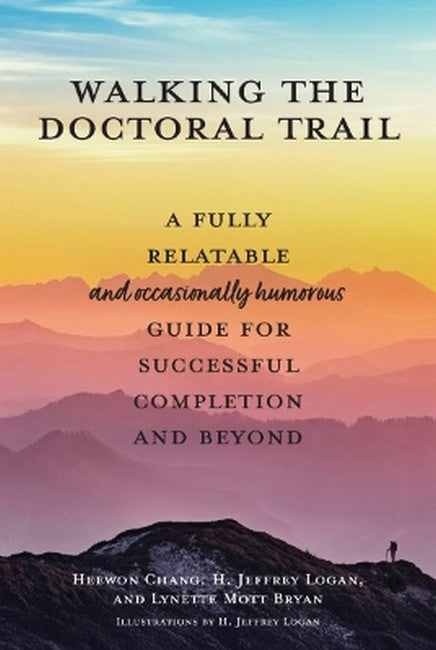

Request Academic Copy
Please copy the ISBN for submitting review copy form
Description
List of Figures Prologue Chapter 1: Trip Plan: Discerning and Prepping 1.1. Know Your Purpose 1.2. Select a Fitting Trail 1.3. Make a Plan for Your Journey 1.4. Identify Funding Sources 1.5. Announce Your Decision and Pack 1.6. Helpful Resources 1.7. Your Trail Notes Chapter 2: Welcome Center: Celebrating and Launching 2.1. Celebrate the Beginning 2.2. Mark Your Trail Map 2.3. Build New Relationships 2.4. Connect with Larger Communities 2.5. Be Open to Changes 2.6. Helpful Resources 2.7. Your Trail Notes Chapter 3: Marked Courses: Following and Advancing 3.1. Establish Your Routine 3.2. Stay the Course 3.3. Collect Treasures Along the Trail 3.4. Trust and Persevere 3.5. Celebrate Big and Small 3.6. Helpful Resources 3.7. Your Trail Notes Chapter 4: Doctoral Wilderness: Struggling and Succeeding 4.1. Survive in the Hinterland 4.2. Strike a Balance 4.3. Avoid Resource Shortage 4.4. Counteract Self-Doubt 4.5. Return to the Trail 4.6. Helpful Resources 4.7. Your Trail Notes Chapter 5: Purposeful Exploration: Searching and Focusing 5.1. Expand Curiosity Purposefully 5.2. Critically Assess Discovered Knowledge 5.3. Identify a Significant Problem 5.4. Improve Study Alignment 5.5. Consider Research Ethics 5.6. Helpful Resources 5.7. Your Trail Notes Chapter 6: Deep Discovery: Finding and Defending 6.1. Collect and Manage Data 6.2. Analyze Data 6.3. Interpret Results 6.4. Prepare Your Research Report 6.5. Defend Your Discovery 6.6. Helpful Resources 6.7. Your Trail Notes Chapter 7: Beyond the Summit: Sharing and Impacting 7.1. Appreciate Accolades But... 7.2. Acknowledge Your Supporters 7.3. Reorient Your Identity 7.4. Apply Your Findings 7.5. Expand Your Impact 7.6. Helpful Resources 7.7. Your Trail Notes Epilogue Heewon's Story Jeff's Story Lynette's Story Final Words from Us Index NOTE: Table of Contents subject to change up until publication date.