
Mark T. Mulder is professor of sociology at Calvin University. Mulder's scholarship focuses on urban congregations and changing racial-ethnic demographics. He is the author of Shades of White Flight: Evangelical Congregations and Urban Departure and coauthor of The Glass Church. He has also published pieces for church audiences and won awards from the Evangelical Press Association and the Associated Church Press for his writing.

Description
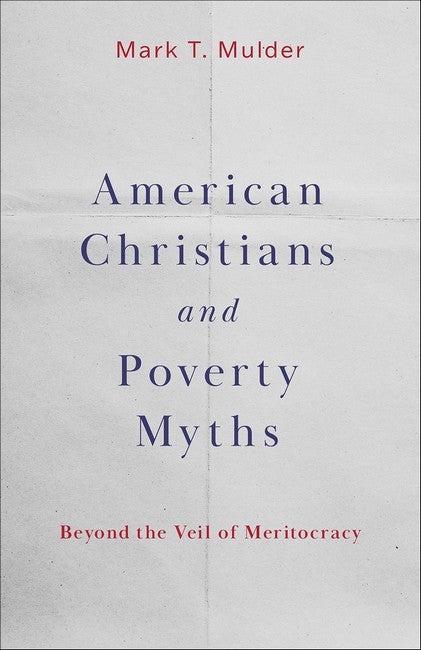
Introduction The introduction advocates for an imperative for Christians to challenge many of our long-held assumptions about poverty in the United States. It argues that viewing poverty as a personal or cultural failure is a deep misunderstanding that, in worst cases, leaves churches unaware of our complicity with the economic violence of structural injustice. The introduction presents an initial orientation to issues of poverty in the United States and what social science data reveals about persistent poverty. Chapter 1: Confronting Popular Notions About Poverty This chapter offers a narrative regarding the current state of poverty. It includes a discussion of who tends to live in poverty in this country in terms of sex, race or ethnicity, and age. In other words, this chapter offers a lay of the land and establishes the significant trends that Christians should be aware of as they consider their missional work. Chapter 2: The Culture of Poverty Thesis This chapter explores the culture of poverty thesis and its lasting sway for many Christians in the United States. The culture of poverty thesis implies that people who are poor need to change their choices and behaviors if they expect meaningful improvement in their lived conditions. Though the thesis has mutated into more sophisticated expressions in the 21st century, it has manifested throughout U.S. history to defend everything from slavery to Jim Crow to the 1996 Welfare Reform Act. The chapter traces the history of the thesis and demonstrates how frequently it is alluded to in politics, entertainment, and news media. Chapter 3: Interrogating the Culture of Poverty Thesis Based on the weight of social science evidence, this chapter argues that the culture of poverty thesis has limited ability to explain modern poverty in the U.S. Study after study demonstrates that people who are poor do not have different values than those who are middle class, upper class, or even wealthy. In fact, the data shows that residents of poor neighborhoods in the United States are rationale calculators in their decision-making and behavior. In addition, the chapter confronts the notion of mobility that is sacredly embedded with the ideal of the American Dream. The implicit assumptions of Norman Vincent Peale's positive thinking, Robert Schuller's possibility thinking, Joel Osteen's rule your day, and Dave Ramsey's financial peace all assert that the right attitude and grit are all it takes to be successful in the United States. The culture of poverty myth lurks largely unidentified beneath these suppositions. In response, this chapter invites readers to consider the critical role of structures and institutions in determining people's lived outcomes. Chapter 4: Evangelicals and Relational Remedies This chapter focuses on Evangelicals and why the culture of poverty thesis holds special appeal for them. Based on social science data regarding Evangelicals and racialization, this chapter explores ways that this population's use of their own cultural toolkit and assured belief in the miracle motif make them especially predisposed to embrace the culture of poverty thesis. The chapter also includes excerpts of interviews with various Christians regarding their understanding of poverty and its sources. Chapter 5: Nuancing Our Understanding of Poverty This chapter challenges Christian congregations, both Evangelical and Progressive, to consider the implications of structural injustice regarding poverty and adopt appropriate responses. Although Progressive churches are more likely to articulate an understanding of structural factors, recent evidence indicates they still tend to implement similar approaches toward poverty as Evangelicals. Furthermore, studies consistently indicate a high level of social service delivery from all types of congregations. This chapter encourages various church leaders to re-evaluate how to best harness their respective resources and capacities to more effectively address poverty. The chapter also argues that if American Christians fail to respond to the structural factors that cause poverty, we risk remaining complicit--Evangelical and Progressive alike--in the systems that perpetuate social inequality in the United States. Rather, responding to poverty in ways that align with a more nuanced understanding of poverty can produce more effective solidarity with a variety of people who have been economically marginalized. Conclusion The conclusion revisits the book's argument about the seductive nature of the culture of poverty thesis and how it influences many Christian congregations. It clarifies potential objections to the book's argument, raises issues yet to be addressed, and speculates on the future of missional engagement from congregations interested in issues of poverty. The conclusion also provides further remarks on the fluid nature of poverty and how significant it is for Evangelical congregations, in particular, to better understand these contours.